The core principle of Idira is this: Every identity is privileged. Every privilege must be controlled.
Privilege used to be reserved for engineering teams and system admins. Now, a login token, service account, cloud workload, or AI agent can trigger workflows, call APIs, or alter code. Even marketing specialists working in a CRM or a finance manager pulling payroll records can become privileged users.
If your identity program can discover these identities, that’s progress. But if you can’t control what they do, your inventory is just a headcount.
Key Takeaway: Dynamic privilege controls extend identity security beyond the login and adjust access as identities act and risk changes. The need is urgent: 83% of organizations reported two or more identity-related breaches last year, and frontier AI now helps attackers compress weeks of work into hours.
Part 1 introduced democratized privilege management and explained why the rigor of privileged access management, or PAM, must extend to every human, machine, and agentic identity that carries privilege. Part 2 explored continuous identity and privilege discovery: finding every identity, entitlement, and access path.
Now we move to the next requirement: controlling privilege at the moment of action. This is the original purpose of identity and access security.
Static Controls Leave Privilege Exposed
For many vendors and security teams, control still means the login.
For human users, that requires single sign-on, or SSO, password management, multi-factor authentication, or MFA, and lifecycle policies. For machines, it’s verifiable cryptographic identity and workload attestation. Privileged access management, or PAM, adds tighter controls for administrators while governance teams periodically confirm that access is still appropriate.
These controls are essential. None provides complete control on their own.
Business is fluid, and permissions change at the speed of humans and machines, including agentic AI. Least privilege is important, but it’s only one part of a strong defense-in-depth strategy that must also include zero trust and an assume-breach mindset.
The problem is that many organizations rely on passwords that are never changed, access policies that are rarely reviewed, weak authentication for sensitive accounts, and permissions that sit dormant 24/7. Without consistent validation, they become sitting-duck permissions: highly visible, unmonitored targets just waiting for someone else to use them.
Dynamic privilege controls extend identity security beyond the login and adjust access as identities act and risk changes.
Discovery can identify and remove access that should no longer exist. Control addresses the next decision: what happens when an identity needs privilege to perform approved work?
Removing these sitting ducks requires a shift from rigid, standing access. Instead, privilege must be:
- Granted for a defined task.
- Evaluated against current context.
- Removed when the work ends.
This reduces the access a compromised identity can inherit and use to move through the environment.
Modernize Control Without Abandoning Vaulting
Idira is built by the team that pioneered PAM. But modern identity security must extend beyond the vault. Organizations need to be able to reduce standing privilege while preserving vaulting for systems that still require it. The three levels below show the span of persistent privilege toward full zero standing privileges, or ZSP.
Level 1: Persistent Standing Access
At Level 1, traditional PAM vaults credentials, rotates static passwords, and records sessions. This is still important for root accounts, built-in systems, and break-glass scenarios. But using standing access to everyday workflows leaves entitlements waiting to be exploited.
Level 2: Just-in-Time Access
Level 2 compresses the exposure window through just-in-time or JIT access. Privilege is time-bound and available only when it’s needed.
JIT reduces standing access, but it doesn’t always eliminate the standing entitlement itself. An identity may retain eligibility or a persistent path to access even when the privilege is not active.
Level 3: Zero Standing Privileges
Level 3 goes further. Users, developers, and machines begin with no standing access by default.
When access is required, Idira analyzes live context and risk, then grants short-lived, fine-grained access scoped to the task. When the task or session ends, that access expires, leaving no standing privileges or long-lived credentials for attackers to harvest or reuse.
The bottom line: Organizations can’t move to Level 3 overnight. Level 3 does not mean replacing your current controls all at once. The Idira Identity Security Platform was built with this in mind. It lets traditional PAM, JIT, and modern ZSP controls run in parallel, giving teams a practical path to full ZSP without ripping out the architecture they already rely on.
Organizations can keep proven vaulting and password rotation in place where needed while gradually extending ZSP across cloud, workload, and workforce access.
Layered Adaptive Controls That Follow the Identity
Dynamic control follows the work across three points: before access, at the access decision, and throughout the session. For autonomous agents operating at machine speed, that control can’t depend on a person reviewing every action.
|
Risk
|
Solution
|
How It Works
|
|---|---|---|
| STAGE 1: BEFORE LOGIN | ||
| Credential attacks leading to privileged access and local footholds | Idira EPM | Removes standing endpoint privilege. Replaces local admin rights with policy-based, on-demand elevation. |
| STAGE 2: AT LOGIN | ||
| High-risk access requests | Idira Identity and Access Management | Secures the access path. Combines SSO with adaptive, phishing-resistant MFA based on identity, device posture and session risk. |
| Credential compromise in SaaS and developer environments | Passwordless experience | Reduces credential compromise. Enables passwordless access through FIDO2 authenticators, passkeys, QR codes and biometrics. |
| Password reuse across legacy infrastructure and nonfederated applications | Idira Workforce Password Management | Reduces password reuse. Vaults credentials for custom, on-premises and nonfederated applications. |
| Identity risk beyond the identity provider | Prisma Browser | Extends protection beyond the identity provider. Secures users and applications beyond initial authentication. |
| STAGE 3: AFTER LOGIN | ||
| Session hijacking and man-in-the-middle attacks | Idira Secure Web Sessions | Extends protection into the session. Monitors workflows and records activity inside protected applications. |
| Administrators acting outside normal patterns | Idira Identity Threat Detection and Response | Turns detection into containment. Flags unusual behavior and triggers stronger authentication or session termination based on policy. |
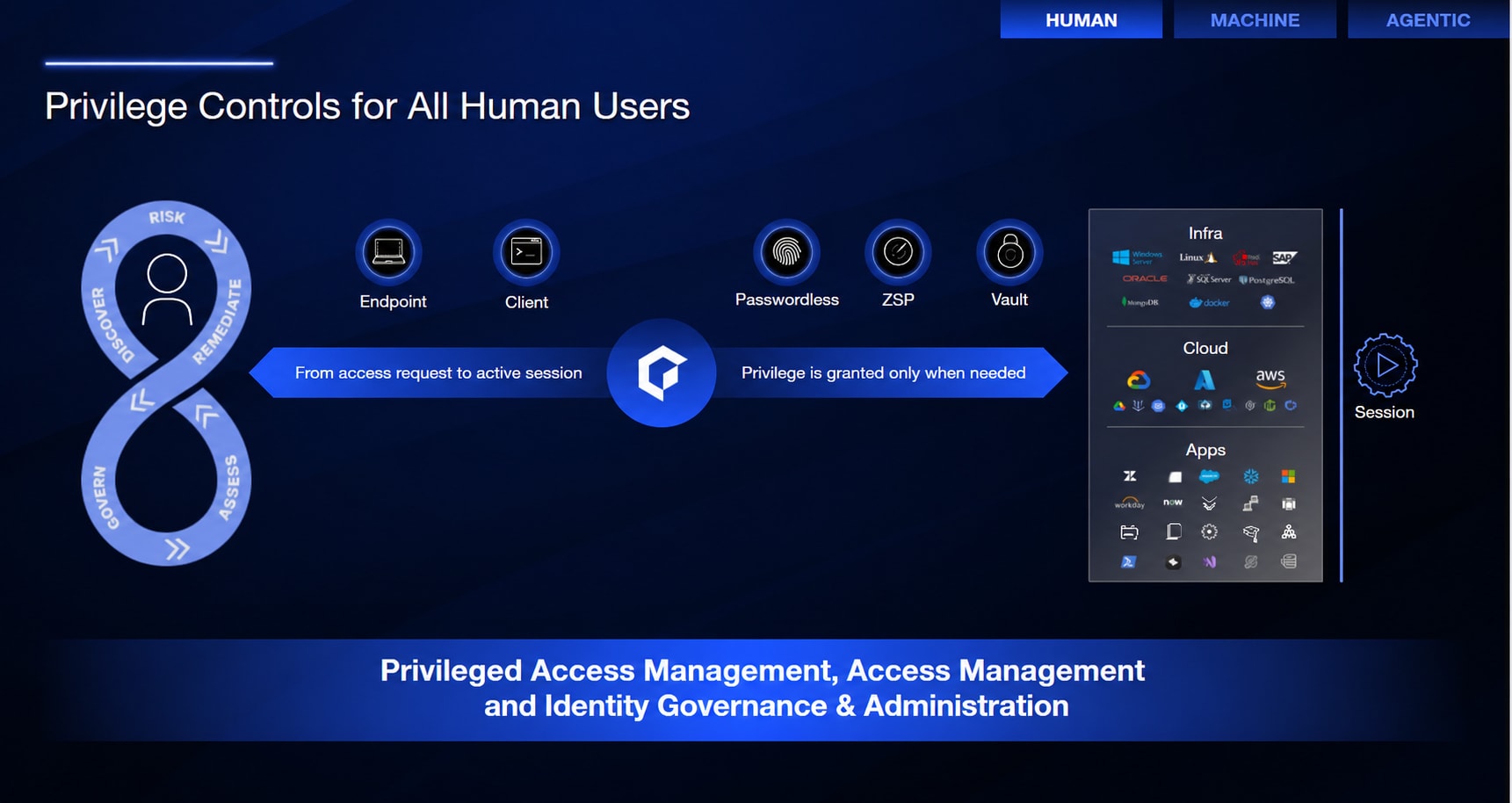
Control Privilege at the Moment of Action
Idira unifies IAM, PAM, and IGA under a single operating model that moves at the speed of agentic AI without disrupting your workforce. Organizations can preserve vaulting where legacy systems require it, replace standing access with task-specific privilege where possible, and continue enforcing policy after login—even for autonomous agents.
Discovery reveals who has access and where it leads. Control uses that context to determine whether that privilege should exist at the moment of action.
Next, we’ll look at governance: how organizations should record and review every decision, exception, and outcome.
Learn more about next-gen identity security.
FAQs
How does dynamic privilege control differ from traditional PAM?
Traditional PAM relies primarily on vaulting credentials and managing login access to legacy infrastructure. Dynamic privilege control extends security across all human, machine, and AI identities, continuously enforcing context-aware permissions before login, at authentication, and throughout the active session.
Can dynamic access controls co-exist with existing PAM vaults?
Yes. Idira allows organizations to preserve traditional credential vaulting and password rotation for legacy systems while simultaneously deploying dynamic, zero-standing privilege controls for cloud consoles, modern workloads, and SaaS applications.
How does continuous session protection secure access after login?
Session protection actively monitors user actions—such as clicks, commands, and workflows—during a live session. Using AI-driven behavioral analytics (ITDR), the platform flags anomalous actions and can automatically enforce step-up authentication or terminate suspicious sessions in real time.
Why is Endpoint Privilege Management (EPM) critical for dynamic access control?
Endpoints are a primary entry point for credential harvesting and lateral movement. EPM removes standing local admin rights across Windows, macOS, and Linux, replacing them with policy-driven, on-demand elevation strictly when approved applications or commands require privilege.