Over the last few years, a distinct paradox has emerged in cloud-native security: our scanning tools have become incredibly accurate, yet our mean time to remediate (MTTR) has stalled.
Container image vulnerabilities have become a wall of non-actionable noise. Today, legacy cloud security tools and exposure management solutions will easily scan your environment to flag hundreds of Common Vulnerabilities and Exposures (CVEs) on a single image. They will even provide a generic "fix version" next to a package name. But for security, platform engineering, and application development teams, that’s where the real work and friction begins.
When you are staring at 250 vulnerabilities on a single container image, you immediately hit a wall of contextless data. Scan tools routinely display "fixed versions" for base-image CVEs, but developers can't simply override those packages; they must wait for a newer base image. Do these vulnerabilities originate from your team’s golden base image, or were they introduced by the application developers when they added third-party libraries? More importantly, what is the safest upgrade path that actually fixes these CVEs without breaking production?
Telling an engineer what is broken is the bare minimum. We need tools that tell us how to safely fix it. To bridge this gap, Cortex Cloud is accelerating vulnerability remediation across your container fleet with a new smart Upgrade Intelligence summary, available directly on container registry image assets.
Cortex Cloud now automatically identifies the underlying base OS image, isolates the scope of every CVE, and evaluates newer, more secure versions already approved within your corporate registry. Let's look at how this fundamentally changes container vulnerability management.
The Root Cause: Ending the Container Blame Game
If you sit in on a vulnerability triage meeting, you will witness the exact same bottleneck of ownership ambiguity.
When application developers investigate vulnerability findings, they often see dozens of critical CVEs living in the base operating system layer (e.g., a vulnerability in libc or openssl). If teams don't control the base infrastructure, they ignore the report. Conversely, platform engineers receive massive lists of CVEs that include application-layer packages (like lodash or log4j), which cannot be safely patched without breaking the app. As a result, vulnerability counts continue to increase quarter over quarter despite massive investments in scanning.
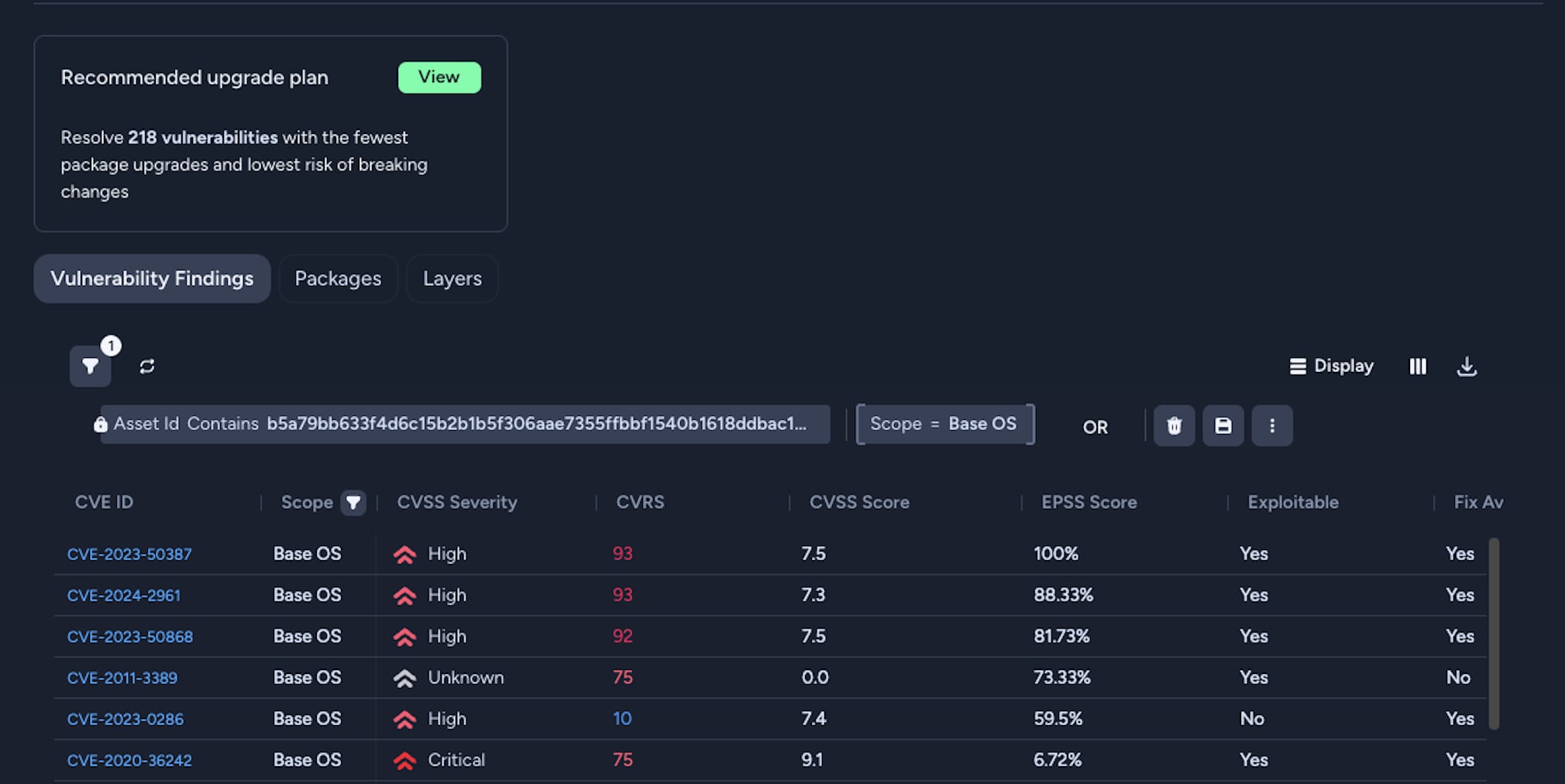
Cortex Cloud eliminates this friction by classifying the base image within the scope of every containerized application. Driven by advanced SBOM (Software Bill of Materials) analysis, the engine evaluates the package type and its origin to classify it as either Application Scope or Base OS Scope.
- For the Application Developer: Teams can now filter their vulnerability view by application. This strips away infrastructure noise, showing only the CVEs in packages they own, along with the specific version they need to upgrade. From here, teams can easily update their package.json or requirements.txt and fix their code without touching the underlying OS.
- For the Platform Engineer / DevOps: Groups can filter by "Base OS" to see only the infrastructure vulnerabilities they are responsible for. This simplifies the backlog, allowing them to quickly roll out a new base OS image.
Intelligent Migration Scoring and Risk Assessment
In the past, teams were given a fixed version for a specific package, but they completely failed to assess the systematic safety of upgrading an entire base image.
Cortex Cloud introduces container image migration scores, which weigh security posture improvements against potential operational risks. When a user opens the new Upgrade Recommendations modal, they are presented with the optimal upgrade path.
The platform evaluates several vectors to provide an Operational Risk Level (Low, Medium, or High). This risk level factors in version distance (e.g., a patch upgrade vs. a major breaking version shift) and distribution compatibility. Furthermore, an upgrade recommendation will never be surfaced if it increases the critical CVE count compared to the current image.
Inside the modal, teams instantly see:
- The Recommended Target: The specific image tag or package version to upgrade to.
- Operational Risk Level: The quantified risk of making the change.
- Remediation Impact: The exact number of Critical, High, Medium, and Low CVEs that will be resolved by taking this single action.
By eliminating hours previously spent researching safe base image tags and cross-referencing CVE databases, teams can transition straight from visibility to action. With clear scope definitions and risk-assessed upgrade targets, organizations are effectively cutting their mean-time-to-remediate (MTTR) in half.
Remediation Leverage: Minimize the Blast Radius
If you have limited cycles to patch infrastructure, you need to know which actions provide the highest return on investment. When analyzing a shared base image (like a Golden Base or a Runtime Stack), Cortex Cloud traverses the graph relationships of your registry to calculate the image's blast radius.
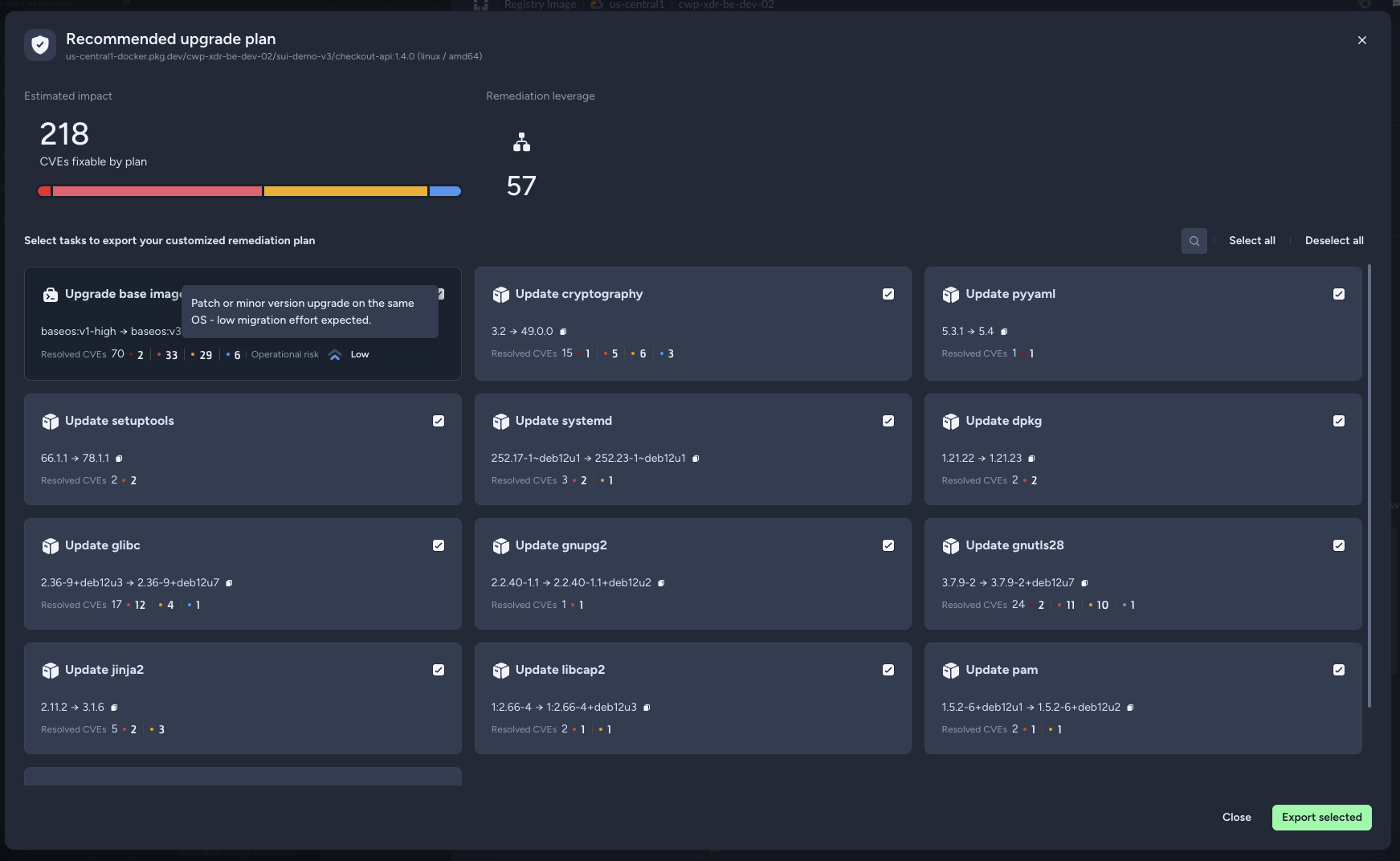
The intelligence summary displays the exact number of downstream, dependent images that will inherit the base image security fixes once it is tagged. This is presented as a primary headline element in the UI. Instead of treating every vulnerability equally, teams can prioritize the single base image upgrade that cascades fixes down to 40, 50, or 100 downstream microservices. By framing the upgrade as a high-leverage security win, teams can minimize the blast radius and improve MTTR.
To bridge the gap between intelligence and daily developer workflows, all of this data is highly exportable. Cortex Cloud instantly generates a detailed CSV remediation table—mapped precisely by scope, package, current version, recommended version, and CVEs fixed. This export is designed to be immediately usable as a Jira ticket list or team assignment sheet, transforming abstract vulnerability data into tangible engineering tasks.
The New Standard for Container Security
For too long, the industry has accepted that container vulnerability management means drowning in unactionable findings. Cortex Cloud is shifting the paradigm with intelligent upgrade recommendations. Moving beyond simply pointing out what is broken and finally giving teams the intelligence they need to safely and rapidly fix it.
Learn more on the Cortex Cloud Container and Kubernetes security page.