Your IdP Identity Provider (IdP) stood in the center of the ring, hyped up the crowd, and made their grand introduction: “And in this corner, weighing in at zero deployment hassle and total vendor consolidation... Featherweight identity governance!”
Key Takeaway: Traditional IdPs rely on group-based models that miss fine-grained application entitlements and lack native privileged access management, or PAM. To eliminate these dangerous blind spots and avoid the fragmentation tax, organizations must unify PAM, identity and access management, or IAM, and identity governance and administration, or IGA, into a single control plane.
To you and your team, it sounded like an easy win. You’d already deployed the IdP’s single sign-on, or SSO, for your cloud applications and federated your infrastructure, not to mention onboarded those first few dozen SaaS apps. When compliance mandates and user access reviews came knocking, turning on a "light" solution seemed like a no-brainer. Especially one that was already part of your IdP.
IdP-driven identity governance promised a simpler way to manage access certification, compliance, and identity lifecycles. So you signed on the dotted line, confident. But after a few rounds, you realized your fighter had their hands tied behind their back. Now, months later, you aren’t meeting audit requirements.
Your team didn’t do anything wrong; the problem is that the traditional architecture of IdP-driven identity governance isn't structurally designed to fight a modern, exponential threat landscape. They’re shadowboxing at the entry gates while attackers are exploiting overlooked, fine-grained entitlements in no time flat.
The Structural Flaw of IdP-Driven Governance
Traditional IdPs operate entirely on a permission model built around user profiles, authenticated sessions, and broad groups. They function as excellent gatekeepers for directory management, authentication, and session control. That’s what they’re built to do.
Their structural flaw emerges when organizations try to use an authentication tool to solve a deep identity governance problem. Effective governance can’t be executed on the surface; it must happen at the individual entitlement level across all applications.
Because IdPs rely heavily on a "push" model via SCIM, they’re forced to link IdP groups directly to application-specific groups. They are built for authentication, not fine-grained permissions management. This is the only configuration pattern they natively understand. If a specific application permission or a specific asset entitlement doesn’t map directly to an existing group in the IdP repository, the IdP is blind to it.
Architecture like this sets a dangerous trap, as most modern enterprise entitlements are issued at the individual level across applications, yet IdPs leave them ungoverned.
Why Featherweight Identity Governance Doesn’t Punch Hard Enough
The IdP approach currently tries to solve the governance crisis with two primary variations of featherweight governance. This category encompasses both standalone cloud identity providers and identity systems provided by enterprise operating systems. Both seek to lure buyers in with promises of a simplified, bundled SKU or a single-pane-of-glass workspace, but both suffer from similar limitations:
- Group-based Blind Spots: They only maintain visibility into permissions that map to roles or application groups. Individual actions, granular resource-level controls, and non-group permissions are ignored, creating gaps.
- The Privileged Void: They lack native PAM capabilities, leaving a risky void between standard identity lifecycle management, or ILM, and high-risk administrative access.
The other path teams take is legacy identity governance, but that is also laden with problems of its own and can become even more complicated than the governance problem a team is trying to solve. The bloated (and often incomplete) implementation is exactly why teams flee to "light" IdP governance, seeing it as a potential shortcut.
But to ensure broad governance coverage (and to satisfy the auditors), you need to see fine-grained application permissions, a feat that isn’t possible with an IdP except for a few applications. To go deep with IdP governance, you have to heavily adopt the vendor's secondary automation layers, building and maintaining a massive matrix of custom scripts that only further burden an already extensive process.
While the initial bundle cost seems low, once you see the limitations, those savings quickly transform into high operational debt.
The High Cost of Fragmented Identity Silos
Future-ready identity security can't be achieved by running IAM, PAM, and IGA in isolated functional silos. When these capabilities don’t share a single control plane, organizations face deeper visibility gaps, heavier tool fatigue, and more costly fragmentation taxes.
Disjointed point products keep your infrastructure on dangerously uncertain footing. When you're constantly off-balance, one wrong move can quickly bring your defense down. And today’s security teams can’t afford an uneven foundation, especially since most are already paying a 12-hour “fragmentation tax” to try to piece together a clean, auditable view of who has access to what.
Building a complete architecture requires moving beyond broad roles to govern specific entitlements, focusing on who has them, what for, and whether it’s appropriate for them to do so. To maintain that oversight, you need comprehensive context of your environment.
Idira Steps Into The Ring
Idira®, the Identity Security Platform from Palo Alto Networks, unifies IAM, PAM, and IGA into a single, cohesive control plane, delivering the technical one-two punch of a full platform while moving with the speed, agility, simplicity, and time-to-value of a modern SaaS engine. That unified architecture also includes enterprise IdP capabilities; the difference is that we don’t ask the IdP to perform the specialized, fine-grained job of an identity governance solution. Instead, each capability does what it excels at while operating through a shared control plane.
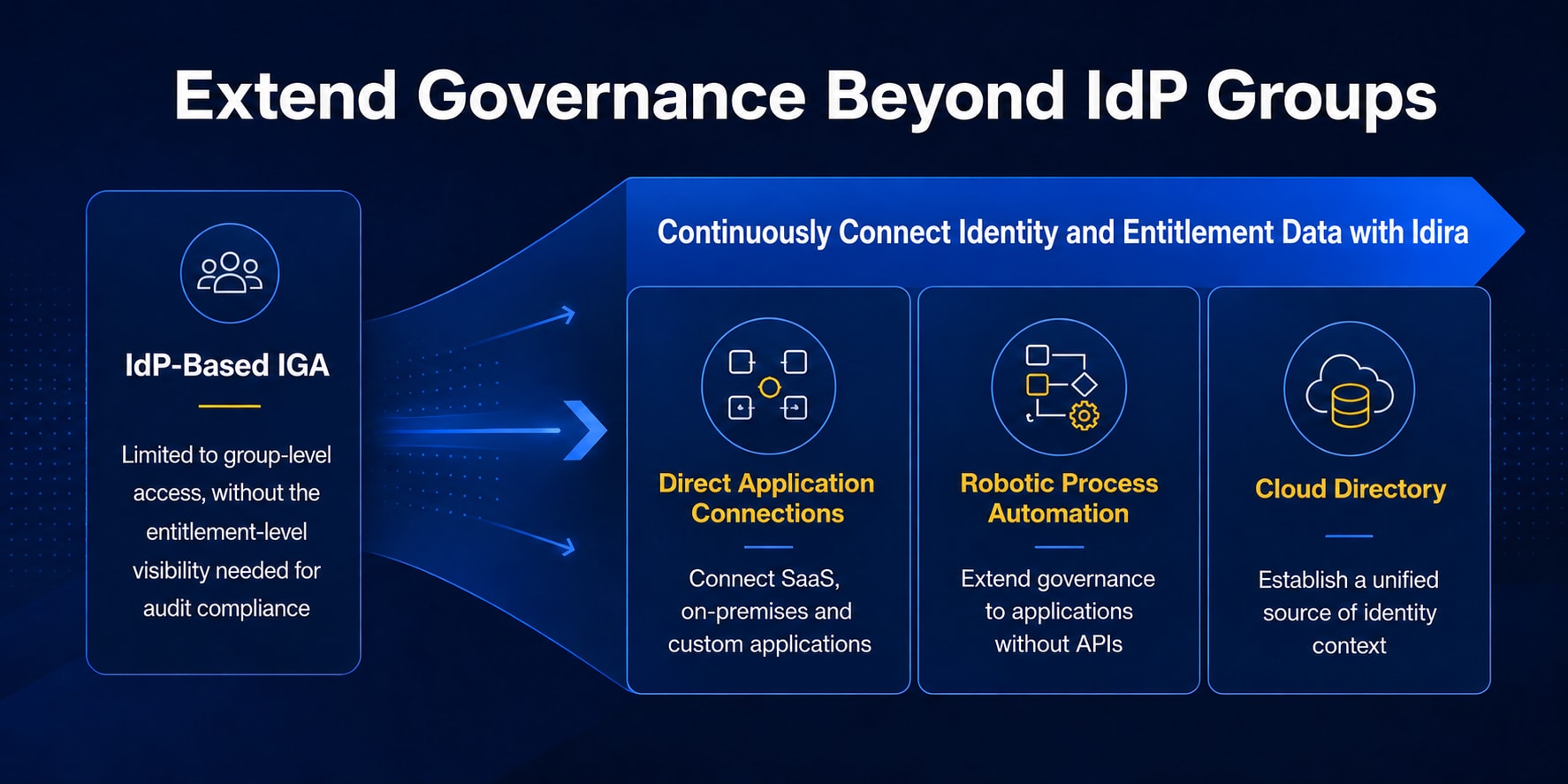
As a result, Idira goes beyond the one-way “push” model of traditional IdPs, which stops at the group level. By connecting directly to your applications and correlating deep entitlement data with our profiles engine, your team can quickly determine who should have access to what, based on both the existing access estate and what the correct business owner has already reviewed and approved.
By going deep to the entitlement level without a complex integration hassle, Idira becomes your team’s full execution, orchestration, and fulfillment engine.
Going Toe-to-Toe with Threats in the AI Era
The threat landscape is no longer human-scale. Machine identities outnumber humans 109 to 1, and 79 of those are autonomous AI agents. Attackers aren’t breaking in; they’re logging in via standing access that should’ve long since expired. More troublingly, Unit 42 research has observed the fastest attackers can move from an initial foothold to full exfiltration in just 72 minutes.
Traditional IdPs are designed primarily for human authentication (like SSO and multi-factor authentication), so they are largely blind to the service accounts, API keys, and autonomous agents making up this massive machine identity footprint
Organizations need strong capabilities that extend beyond authentication:
- Continuous, Comprehensive Visibility: Map every access path across every system—on-premises, SaaS, public and private applications, workloads—and every identity type, surfacing hidden entitlements and risky combinations automatically.
- Zero standing privileges or ZSP: Replace static, always-on accounts with dynamic, just-in-time access. Privilege exists only in the exact moment of use, shrinking an attacker's lateral options to zero.
- Surgical Remediation: Automatically remediate specific access risks and close IdP visibility gaps in seconds.
Strengthen Identity Governance Beyond the IdP
Although IdP-based IGA solutions claim to provide the capabilities you need, most of them are missing a required, granular level of permissions governance. Use your IdP for what it excels at: robust directory services, authentication, and cloud SSO—but leave deep, individual entitlements to a purpose-built security platform that provides a foundation of technical certainty built on three operational pillars:
- Audit-ready Governance: Achieve fine-grained entitlement tracking across cloud infrastructures, legacy on-prem systems, SaaS environments (like Salesforce and Snowflake), and applications that don’t support deep governance for IdP groups.
- Hybrid Support: Maintain consistent, centralized governance across complicated enterprise ecosystems with broad platform coverage.
- Operational Efficiency: Secure your existing environment using easily-configured integrations, bypassing the complex infrastructure reconfigurations needed to turn an IdP into a governance tool.
Consolidating security shouldn't mean leaving your most critical permissions ungoverned. Eliminate the high operational debt of lightweight compromises and achieve total control over your enterprise entitlements with Idira. Schedule your demo today.