Federated learning is a distributed method for training machine learning models in which multiple devices or organizations collaboratively learn a shared model without transferring their raw data.
Each participant trains the model locally on its own dataset and shares only model updates or parameters with a central server. The server securely aggregates these updates to improve the global model while keeping individual data private.
How does federated learning work?
Federated learning uses a simple but powerful cycle. It trains a shared model across many participants—like devices, organizations, or data centers—without ever moving the raw data.
Here's how it works.
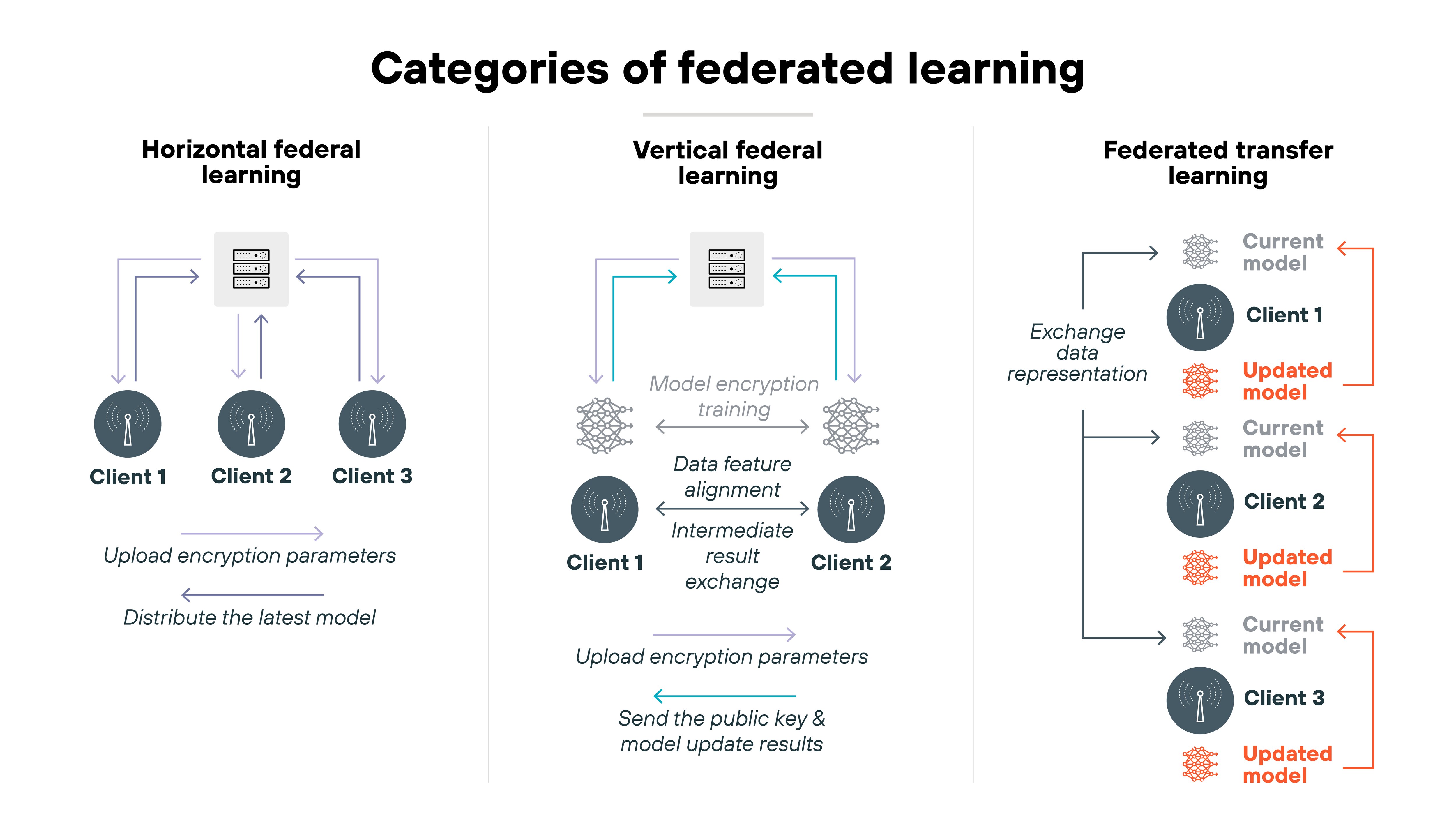
- Horizontal FL (HFL) combines data from participants with similar features but different users, such as multiple hospitals training on patient records.
- Vertical FL (VFL) merges participants with shared users but different data types. Like a bank and retailer sharing insights about the same customers.
- Federated transfer learning (FTL) connects organizations with little overlap in either users or features.
In simplified form, the process looks like this: clients train locally → encrypted updates → central server aggregates → new global model.
Why is federated learning considered privacy-preserving?
"The application of federated learning with GenAI is reshaping industries and creating new opportunities for leveraging data without compromising privacy. Federated learning enables the training of generative models across decentralized data sources. Rather than centralizing data in one location, the model is trained across multiple devices, and only the model updates are shared. This means that sensitive data never leaves the local device, providing an additional layer of security."
Federated learning is built on a simple idea: keep the data where it is.
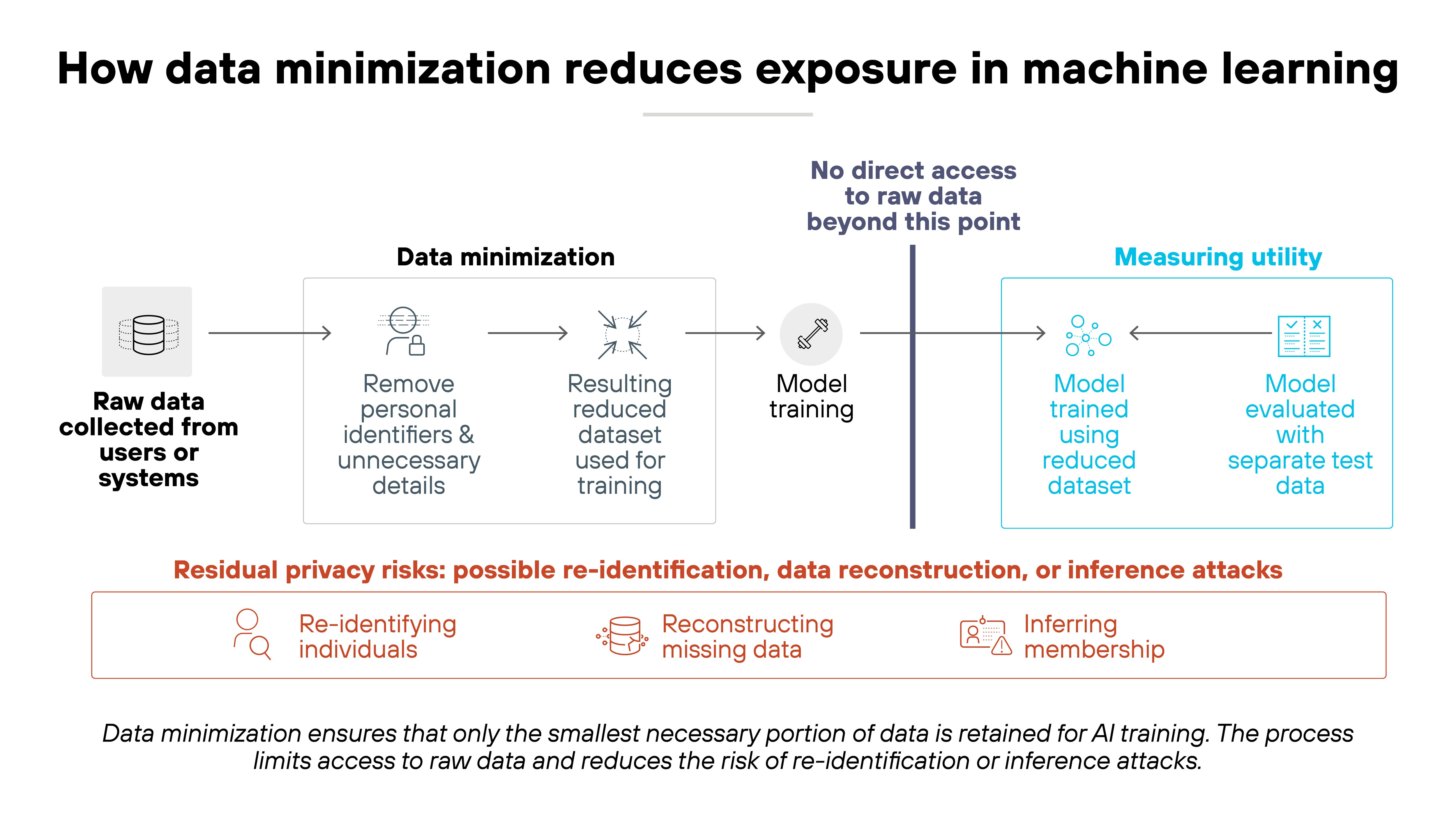
It applies the principle of data minimization. Which means raw data never leaves the devices or servers that create it. Only model updates or learned parameters are shared.
Here's why that matters.
In traditional machine learning, data is pooled in one place for training. That centralization increases exposure risk.
But federated learning removes that single point of failure. Each participant trains locally and contributes only to model improvements. Not data collection.
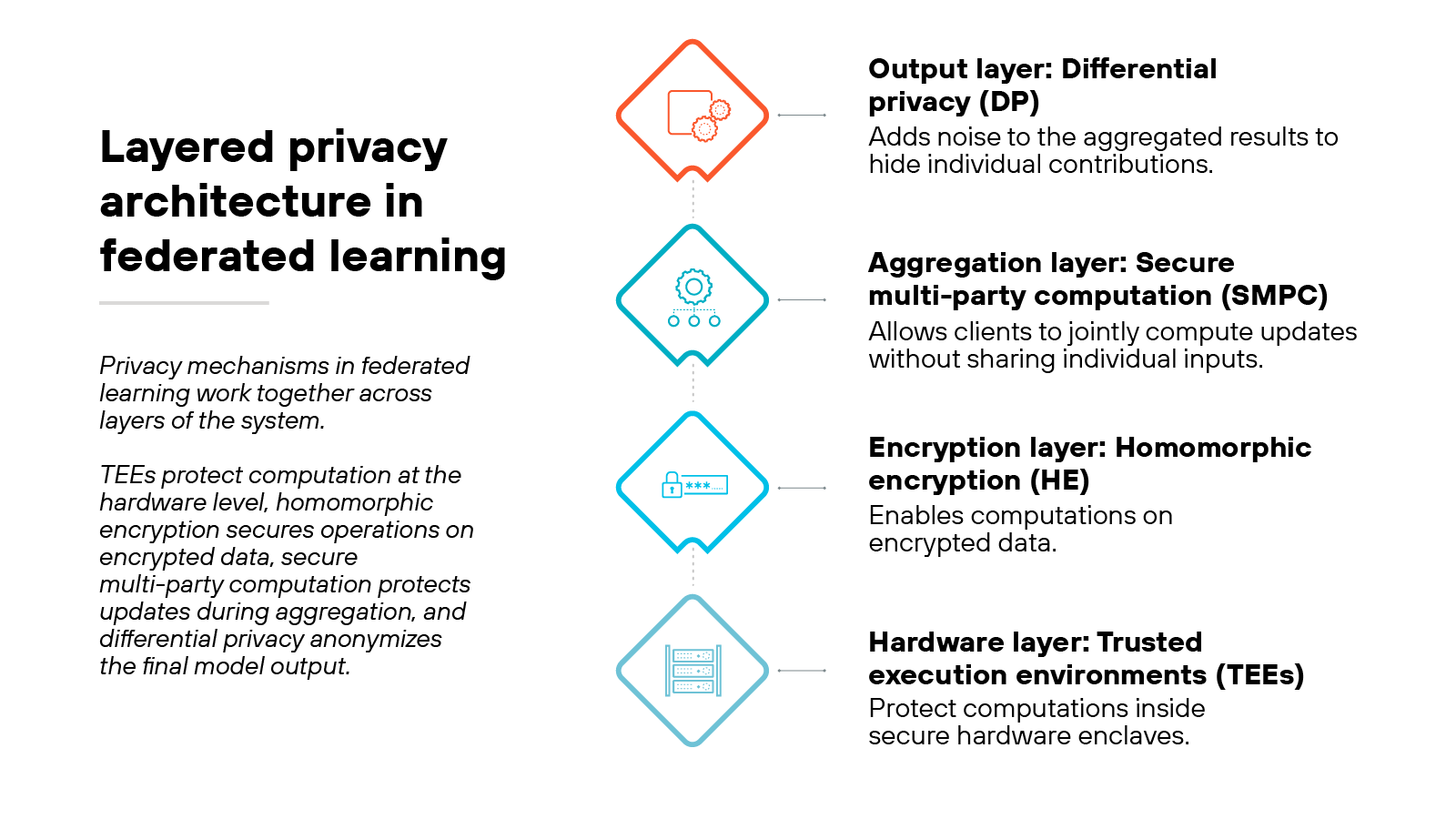
Now, privacy in this system comes from multiple protective layers.
-
The first is secure multi-party computation (SMPC).
It allows several parties to jointly compute results—like combining model updates—without revealing their individual inputs. No participant can view another's data.
-
The second is homomorphic encryption (HE).
It enables computations on encrypted data. In other words, the system can process updates while they remain unreadable to anyone, even the central server.
-
The third is differential privacy (DP). It introduces small amounts of statistical noise to model updates. That makes it mathematically difficult to trace any update back to a specific user or record.
-
And finally, trusted execution environments (TEEs) provide hardware-level protection.
They isolate sensitive computations within secure enclaves that prevent tampering or unauthorized access.
Together, these methods form a layered defense. Each technique covers gaps the others leave open, providing stronger overall privacy.
Note:
Federated learning isn't immune to every risk. Adversaries can still attempt gradient inversion or model inference attacks to reconstruct sensitive details from shared updates. That's why privacy-preserving techniques must keep evolving as the technology matures.
What are the main challenges of federated learning?
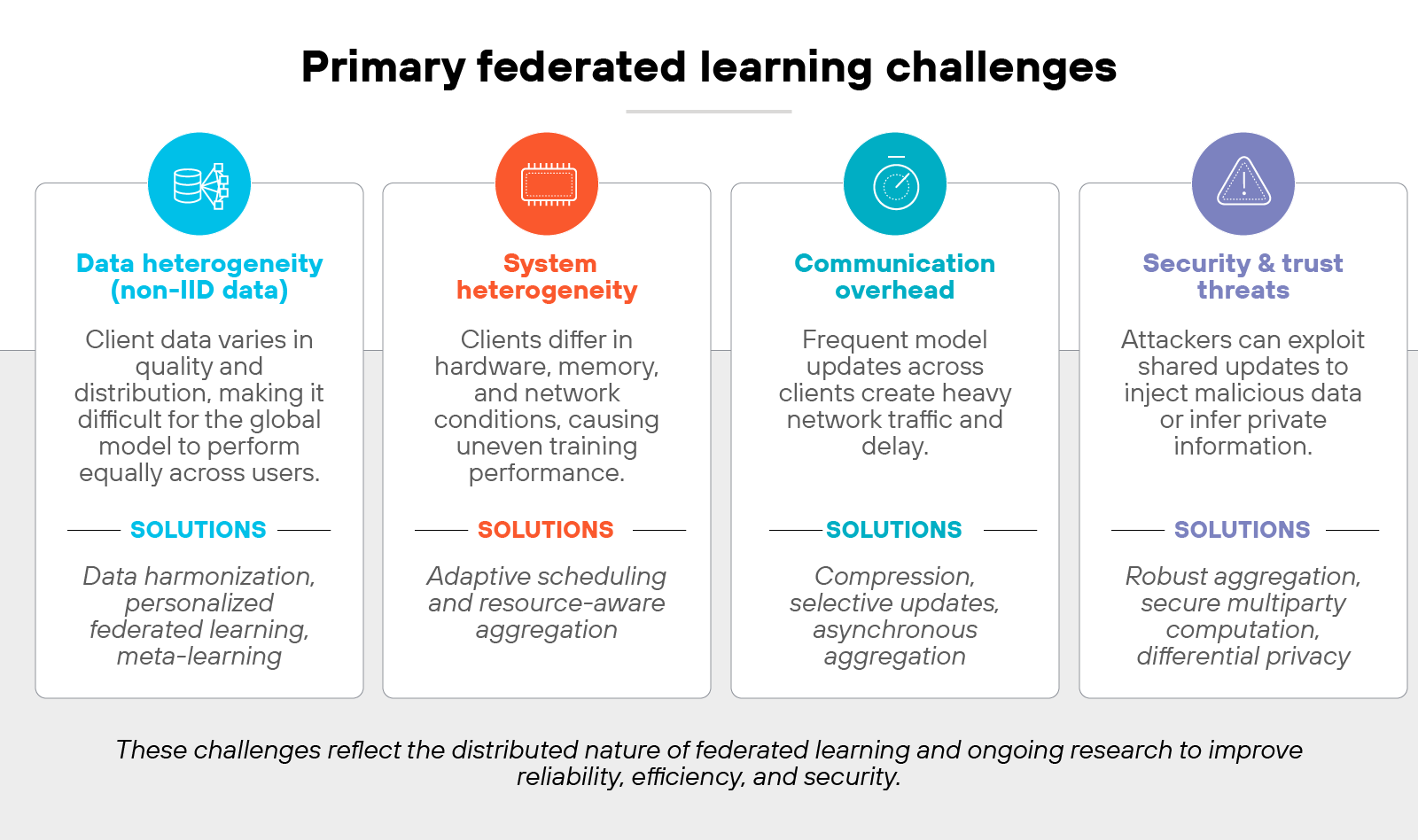
Federated learning has clear privacy benefits, but it also introduces new technical and operational challenges. These challenges come from how distributed the system is and how much it depends on consistent communication, performance, and trust.
Data heterogeneity (non-IID data)
Each participant's data looks different. Some have large, clean datasets. Others have small, inconsistent, or biased ones. That difference—called non-independent and identically distributed (non-IID) data—makes it harder for a single global model to perform equally well across all users.
Here's why.
When data distributions differ, local model updates may conflict. That slows convergence and reduces overall accuracy.
Researchers are exploring data harmonization, personalized federated learning, and meta-learning to make models adapt better to each client's unique data.
Note:
Non-IID data can also lead to fairness gaps, where models perform better for dominant data sources and worse for underrepresented ones. Weighted aggregation and client clustering are emerging as potential ways to reduce these disparities.
System heterogeneity
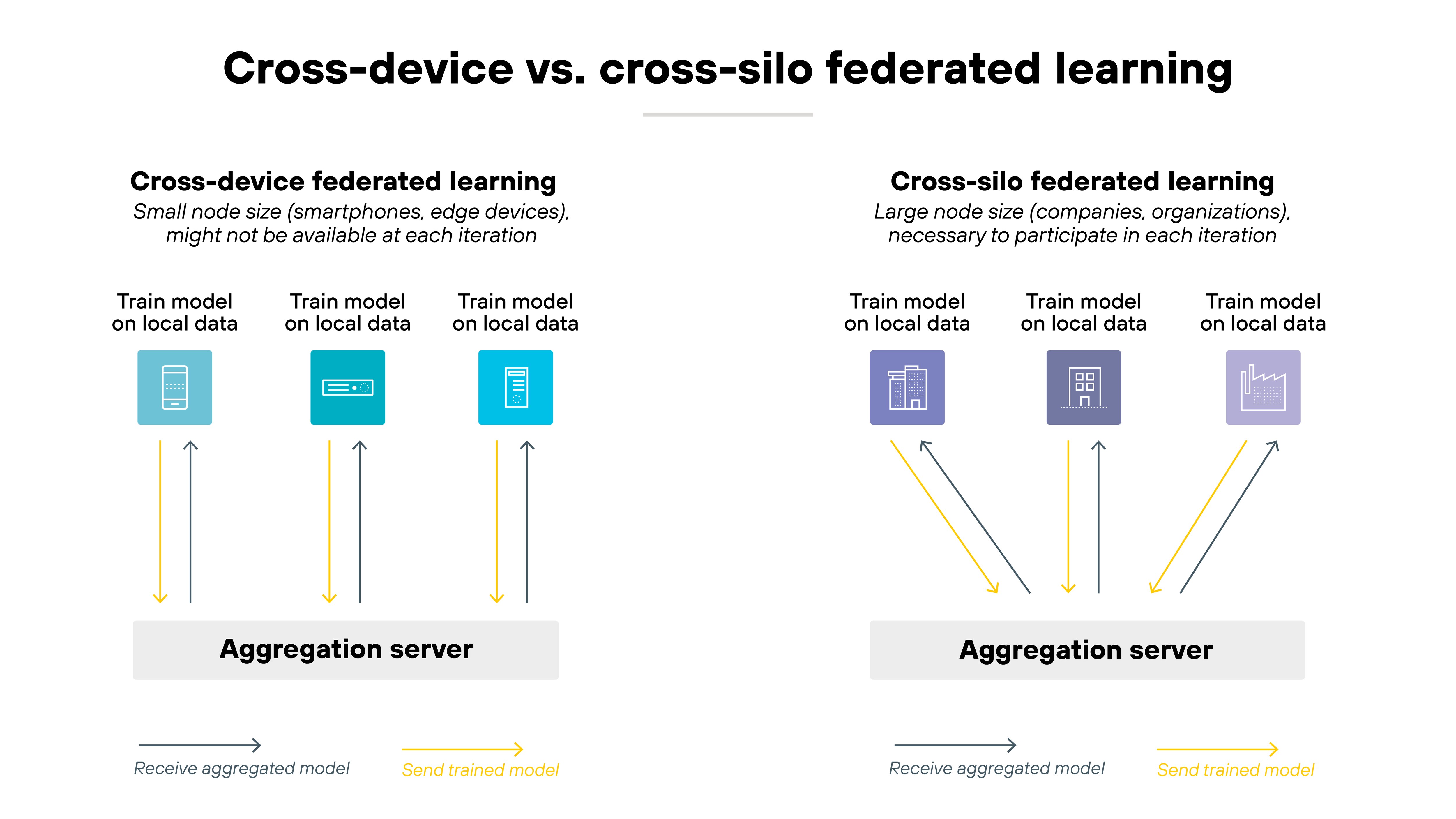
Devices in a federated network don't all look the same. Some are high-end servers. Others are low-power edge devices or mobile phones. Which means training speeds, memory, and network conditions vary.
This variation leads to inconsistent participation and dropped connections during training. Adaptive scheduling and resource-aware aggregation techniques now help balance workload and keep models learning efficiently across different environments.
Communication overhead
Federated learning depends on repeated message exchanges between clients and the server. Each training round involves sending and receiving model updates. At scale, that's a lot of network traffic.
Compression, selective update sharing, and asynchronous aggregation methods are reducing the bandwidth burden. But communication efficiency remains a central focus of ongoing research.
Note:
In real-world deployments, communication costs often exceed computation costs. Engineers frequently adjust synchronization frequency—trading accuracy for network efficiency—to make large-scale training feasible.
Security and trust threats
Even though raw data stays local, federated systems can still be attacked through shared model updates. Malicious clients can inject poisoned data, alter gradients, or exploit patterns to infer private information.
Robust aggregation, secure multiparty computation, and differential privacy help defend against these risks. However, attacks like Byzantine faults and model inversion continue to challenge how securely federated systems can scale.
These security implications—and how they shape AI risk management more broadly—are explored later in this article.
Where is federated learning used today?
Federated learning is no longer experimental. It's now part of how organizations handle sensitive data while still training effective AI models. The technology supports sectors where privacy, regulation, and distributed data make traditional centralized training impractical.
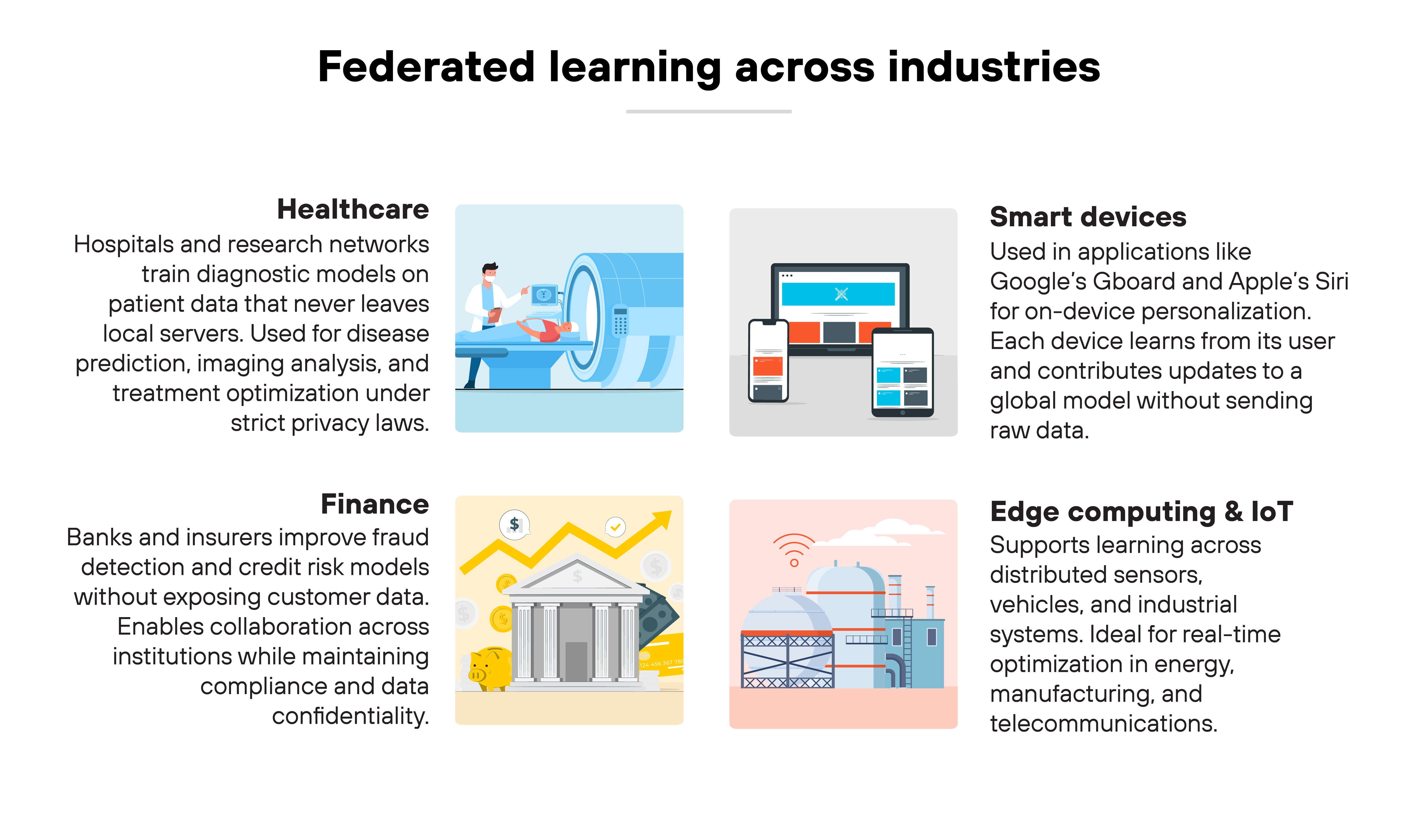
Healthcare
Hospitals and research networks use federated learning to train diagnostic models on patient data that never leaves their servers. That means predicting diseases, improving imaging analysis, or identifying treatment patterns without sharing confidential records.
For example(s), institutions can collaborate on cancer detection or medical imaging projects while maintaining compliance with privacy laws.
Finance
Banks and insurers use federated learning to improve fraud detection and credit risk models. It allows them to learn from transaction data held in different institutions without exposing customer information. This approach reduces regulatory risk while improving model accuracy across diverse datasets.
Smart devices
On-device applications like Google's Gboard and Apple's Siri use federated learning for personalization. Each device learns from its user—improving text prediction or voice recognition—while updates contribute to a shared model.
The data itself never leaves the device.
Edge computing and IoT
Federated learning extends to industrial systems, connected vehicles, and IoT networks. It enables models to learn from distributed sensors and devices where bandwidth is limited and data privacy is critical. That makes it suitable for real-time optimization in sectors like energy, manufacturing, and telecommunications.
Ongoing deployments by companies such as Google, Apple, and Meta—and partnerships with academic consortia—continue to expand how federated learning is applied across industries.
How is federated learning evolving?
Federated learning is entering a more mature phase.
The early goal was simple: keep data local.
Now the focus is expanding. Researchers are building systems that are not only private but also reliable, transparent, and auditable.
Here's where it's heading.
"In recent years, practical FL systems have harnessed significant advancements by the community: we can scale to millions of devices and many domains; we can apply secure multiparty computation protocols at scale and combine them with central or distributed DP; we can successfully train production models with meaningful DP guarantees while achieving high utility."
The field is moving toward what's known as trustworthy federated learning.
It combines privacy, robustness, and security into one unified framework. The idea is that a model should protect sensitive data, detect manipulation, and verify the integrity of updates before they're merged into the global model. In other words, it's about establishing measurable trust in how learning happens.
At the same time, federated learning is being connected to large-scale AI.
Researchers are exploring how to train or fine-tune foundation models—including vision and large language models—on distributed datasets. To support that scale, confidential computing is emerging as a key enabler. It provides isolated, verifiable environments for handling sensitive model updates.
The supporting infrastructure is evolving too.
Trusted execution environments (TEEs) now allow training steps to occur inside secure hardware enclaves that can be independently verified. When paired with ledger-based verification, these systems can record which computations occurred, under what privacy guarantees, and by whom. That gives organizations the ability to audit and prove compliance.
Finally, federated learning is branching into new areas such as federated analytics.
Which applies the same privacy-preserving approach to data analysis, and personalized federated learning, which adapts models to individual participants.
It's worth noting, though, that open research questions definitely remain. Scalability, fairness, and verifiability are still being refined as federated learning grows from a privacy technique into a broader framework for secure, distributed AI.
How does federated learning impact AI security?
Federated learning strengthens AI security by changing where and how data is used.
Instead of pooling information in a central repository, it keeps data distributed across many devices or organizations. That shift limits the number of access points attackers can target.
Here's why that matters.
By enforcing data locality, federated learning reduces the risk of large-scale data breaches.
Attackers can't reach an entire dataset by compromising a single server because the data never leaves its source. It also aligns with secure AI design principles like least privilege and defense in depth—each participant only processes what it needs to contribute to the global model.
Plus, federated learning supports confidential computing, where sensitive workloads run inside secure hardware environments.
These systems protect training operations from tampering or interception, even by insiders. Together, these approaches make AI pipelines more resilient to unauthorized access and data exposure.
However:
Privacy doesn't eliminate risk. Federated learning does introduce new attack surfaces through shared model updates.
Malicious participants can inject poisoned data, manipulate gradients, or attempt inference attacks—techniques that reconstruct private information from model behavior. Defending against these threats requires strong cryptography, model validation, and anomaly monitoring.
It also demands trust in the aggregation process itself. Servers that combine updates must be verifiable and governed by strict policy controls to prevent manipulation.
In short: federated learning enhances AI security by decentralizing risk. But it also creates new responsibilities for organizations to secure distributed systems end to end. It's both an advancement and a challenge. And it's central to how privacy-preserving AI ecosystems are being built today.
| Further reading:
RESEARCH: THE STATE OF GENERATIVE AI 2025
See how GenAI adoption, risks, and strategies are evolving across 7,000+ orgs.
Download report
Federated learning FAQs